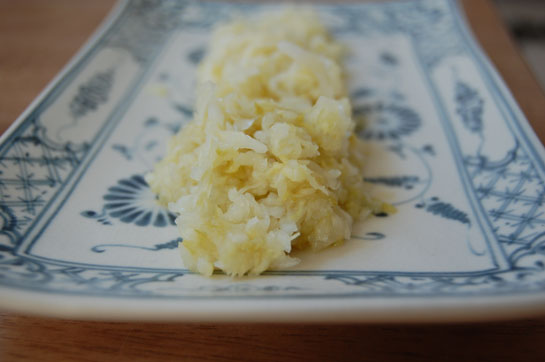
 Tangy, crisp, flavorful sauerkraut is so refreshing on a hot day! It makes the perfect side to many grilled meats. Culinary benefits aside, it’s also healthy for you! In my recipe, I share a little secret that makes for a no pound sauerkraut. No more pounding your cabbage for 15 minutes in this recipe! It’s so easy.
This is the crock method (read about the different methods here) but I am doing it without the crock as I still haven’t decided what I want to buy. Meanwhile, I can make a mean sauerkraut with a big nonreactive bowl (I use glass) a plate, and something to weigh it down.
I find that sauerkraut made in the mason jar method just doesn’t taste right to me, but this? Oh… my…. lands (as my great grandparents would say), I could definitely eat a huge bowl of it in one sitting! It has just the right amount of tangy sourness.
And guess what? You only need cabbage and salt to make it! This is one of the most frugal ways to get beneficial bacteria (probiotics)! Most sauerkraut in the stores is no longer fermented but made with vinegar and the lacto-fermented versions are generally a little over our budget.
And speaking of frugality, don’t forget about Pennywise Platter Thursday coming up!
So here we go!
Old Fashioned Lacto-Fermented Sauerkraut
- 5 Pounds Cabbage (about two heads, organic preferable)
3 1/2 tablespoons coarse sea salt (unrefined)
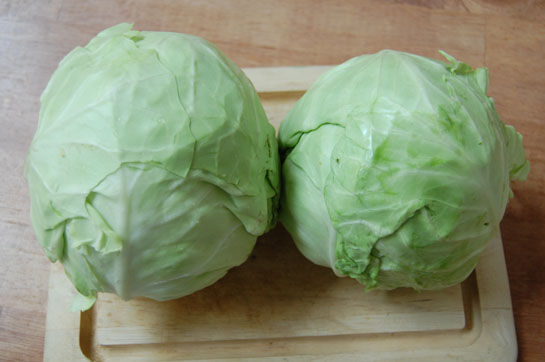
First make sure that all dishes used for this project are very clean. You will need a crock or a large non-reactive bowl, such as the glass one I used, a plate that fits snugly inside and something to weigh the plate down. I used a food grade plastic bucket full of water, a mason jar full of water, another bowl full of water, or a jug full of water, are all options.
1-Shred cabbage (if you have one, a food processor makes this step a cinch) and place in the bowl or crock you will be fermenting in. Toss with the salt and cover with some kitchen towels. Leave for 15 minutes to an hour to allow the salt to draw out the juices of the cabbage. This is the secret that makes this recipe pound free. I learned it in a Russian cookbook.
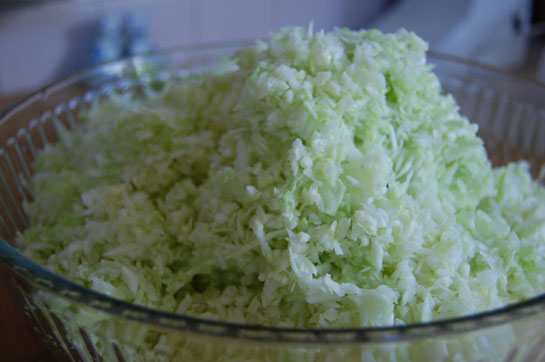
2-Using a mallet, or whatever you have on hand gently pound the cabbage down so that it’s tight fitting in the bowl. Place the clean plate on top and weigh it down with whatever you are using for the purpose. Press down gently, but firmly. The liquid from the cabbage should rise to the top. You will want the liquid to cover the plate with room to spare within in 12-24 hours. If it hasn’t risen above the plate by that point, make up some salt water my mixing one cup of filtered water with one teaspoon of sea salt and use as much as you need. Cover with kitchen towels or a clean pillow case to protect it from flies and dust.
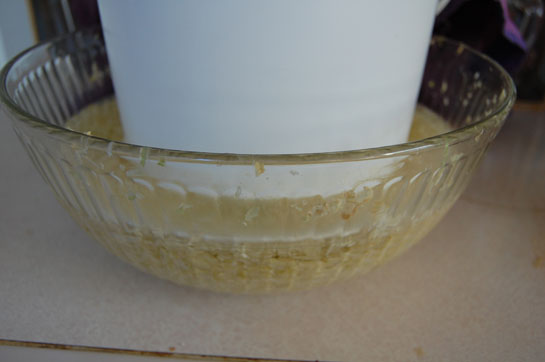
3-Each day you will remove the plate, and rinse it. If there is any “scum” on the surface of the water, remove as you much of it as you can with a spoon. Start tasting the sauerkraut after a few days. It will start to sour within a few days and will continue to “ripen” as the days go on. How quickly it ferments will depend on the temperature of your house. We like it after about ten days. Before that point, we just think it lack the depth of flavor we want. But the lovely thing is that you can stop the fermentation process when it tastes good to you.
4-When it’s fermented enough for your taste, Bottle it up in clean mason jars, and place in the refrigerator where it will keep for a long time. 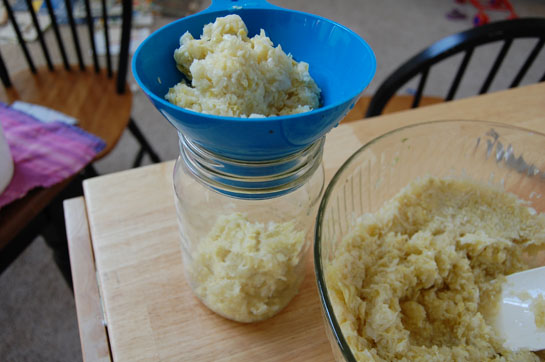
And that’s it!
More resources:
Wild Fermentation’s Crock Method (the same as above)
Trouble Shooting

Latest posts by KimiHarris (see all)
- Eating for Comfort and Sustenance - May 20, 2025
- Perfect Instant Pot Black and Brown Rice - February 14, 2025
- What Worked and What Didn’t in My Cooking Life Last Year - January 14, 2025
I just started my first batch of sauerkraut and can’t wait to taste it soon. Maybe I’ll try this method next time!
Gonna have to try this 🙂
In rinsing the plate I am assuming you just lift the plate, rinse and replace it – don’t do anything with the cabbage?
To store – do you need to “seal” the jars or just put in a glass jar with a screw lid ok?
Amy,
Good luck on the sauerkraut!
Jen,
Yes, just take it out and rinse it. 🙂 And yes, you don’t need to seal the jars by canning, etc. All that’s needed is an airtight seal, which a jar with a screw lid does perfectly. Great clarifying questions.
I made my first batch of sauerkraut last year in a detox course (she called it “cultured vegetables”) and we didn’t even use the bowl/plate as the interim vessel–we just packed it in jars and let it sit on the counter. I’ve been making it that way ever since–I am really very lazy and probably wouldn’t do it if it were more difficult! I love adding grated carrot or daikon radish as well. The possibilities really are endless!
Do you have the recipe you used when you just packed them in jars and let them sit on the counter. I think that is the way Mpm always did it but I would love to have the recipe. Thanks
Is stainless steel considered non-reactive?
Beautiful!
I made some of this a few weeks ago, and really like it. Today, I took a handful of it and squeezed it out and mixed it with an egg, some sprouted flour, green onions & caraway and fried it in butter like a potato pancake.
I just bought two organic heads of cabbage knowing I was going to be trying my hand at making homemade sauerkraut – perfect timing! I made three jars of pickles this evening trying to use up the abundance of cukes, and can’t wait to try them. Here in the northeast (NY) we are suffering from late blight – had to pull three huge beefsteak tomato plants and it looks like the rest – my romas – are next 🙁
I hope you are enjoying your summer and staying cool out there ;o)
Thanks Kimi!
I just learned about the no-pound method recently, which seems much easier than pounding! I’ve only had the mason jar sauerkraut, I’ll have to try your method next to see the difference. Didn’t grow up eating it, so I don’t really know what I’m trying to taste. We do like this and eat it the most of any lactofermented veggie- very hubby friendly and it goes on his sandwich daily.
Wonderful!! Will give it a try soon, Kimi! Thanks for sharing this method.
oh thank you, thank you, thank you. You have a very timely post here for me. I have two heads of cabbage in my fridge from the csa and desperately need to use them up quick. I’ve been meaning to search for an easy saurkraut recipe and it’s just slipped my mind. Appreciate it!
Jenny,
I wouldn’t use stainless steel. Sorry! I think it’s considered reactive.
Clay, enamel, glass, plastic (which I would not use), and stainless steel are all considered non-reactive. It was a great question that I had always wondered about, too, so I looked it up. Live in Victory!
Love the no-pound method!! Thanks so much for sharing – good pics too :))
Oh, I’m excited about this! I’ve tried it in mason jars, pounding it, and we were just not thrilled with the results. Most of it didn’t get eaten, sadly.
However, this looks simple and I love that it doesn’t require buying a true fermenting crock, which I am just not ready to shell out the money for yet. Next time I’m ready to try making sauerkraut again, I will definitely try this method!
I love sauerkraut and am looking forward to trying my first batch with this recipe. Just wondering how everyone uses it day to day. My husband claims he hates the stuff and I’m not sure if I alone could easily/quickly eat several quarts of it!
Hi Kimi,
You prompted me to try my hand at sauerkraut when you posted about eating raw crucifers. I stumbled on the Wild Fermentation site and quickly began the process. I picked up 14 heads of organic cabbage for $1 a piece at a local farmers market (found through localharvest.org) and purchased a very large food grade plastic bucket from a restaurant supply store. I’m hoping you can answer a few questions I have to make sure I’m on track – today is day 8.
1. can you touch on the ‘normalness’ of the smell (it doesn’t smell so great).
2. what can I do if it tastes too salty (because it does)?
3. can I snap on the lid for the container or does it have to sit loosely on the top?
4. when it’s finished, how long will it keep in the fridge? weeks, months?
Thank you so much for your wonderful writing and your wealth of knowledge!
KH: 1-Smell should not be foul, but it could still smell a little funny.
2-How much salt did you use? It should be salty, but overly so.
3-This method, you don’t put on the top,
4-It will last at least months
Hope that helps!
Kimi – I’m stuck on the snugly fitting plate. How snugly is the plate supposed fit into the bowl? My bowls are bigger on the top than on the bottom, so what’s snug at the top won’t fit at the bottom and vice versa. Thanks!
KH: The plate should be able to go down enough in the bowl to press firmly on the sauerkraut, but it shouldn’t be so small as too not hold down the majority of the sauerkraut. The cabbage should fill up most of the bowl so that it works with the plate on the top.
Thanks for this! Before I go ahead and start, I was wondering if you could describe the smell. Does it make your whole kitchen smell like sauerkraut during the fermentation process?
KH: It does have a distinct smell, but I have never noticed it smelling up my whole kitchen. 🙂
Thanks for this! I’m going to try it right now! You might want to add it to your recipe list, I didn’t find it there and I’ve looked a couple of times.
I obviously used too much salt. It is so salty I can’t eat it. It also did not bubble or have any film to wash off. It’s been 5 weeks and it still doesn’t taste like sauerkraut; just VERY salty cabbage with a slight taste of kraut. Is there anything I can do to salvage it?
Doug,
If you use too much salt it can actually preserve the cabbage without allowing it ferment. They used to preserve vegetables that way and then would rinse the vegetables off before using in cooking. That’s what I am guessing you did. 🙂 Sorry about that!
Is there any reason why you couldn’t make a half recipe, with just one head of cabbage?
I mixed this up 6 days ago and I just tried a taste. It has a great tangy taste to it. It’s still a bit salty. It has a nice crunch to it. I used purple cabbage so it is very bright – seems to add to the character. I think I’m going to leave it for another day or to in hopes that the saltiness goes down a bit. Thanks for sharing the recipe and technique.
Hi Jean,
Sauerkraut is a bit salty, though we love salt. 🙂 I just changed the recipe to reflect this, but I realized recently that I use a pretty coarse salt, which is not going to be as salty per tablespoon as the typical fine salt is going to be. If you used a fine salt it would taste more salty than a coarse salt would. The recipes I was going off of, I realized, also call for coarse salt. So, I am not exactly sure how much of a fine salt one would use.
I plan to make the sauerkraut. I haven’t made it since I was a teenager. (I won’t say how long ago that was ha ha). Anyway my mother and grandmother made sauerkraut the way you describe but she canned it (I think waterbathed) it in quart jars when it was finished. So I don’t know how long to waterbath the kraut. I do not have refrigerator space and I plan to make 20 heads cabbage into kraut. Please send an e-mail with the instructions. Thanks
Mary
We just made our second batch following your recipe. Very easy, and great results! Thanks!!
Iwas wondering…my recipe says to bring slowly to a boil….
then hot bath 20 min for quarts.Do I have to do this or can I just pack it into hot jars and seal with hot lids. I dont want want to destroy the benifits of the kraut. Thank you
judy
My cousin told me that they place a cucumber in the middle of the chopped cabbage and leave it until the sauerkraut is ready and you have a very good pickle… I want to try to make your recipe… I tried using the mason jars and after waiting a month, it had a terrible taste and I had to throw it out… Oh, I was disappointed for my husband and I couldn’t wait for that first batch… Sauerkraut is such a fantastic health food… And I wish I knew away to make a lot of sauerkraut juice to drink… Thanks for sharing, I enjoy your blog…
Hi! Thanks for all the great recipes.
My husband and I read NT and haven’t turned back. We’re in a very bad economy right now, so I am a stay at home Mom, and I cut corners when I can.
My husband has been really dying for a crock- and I found one for a VERY reasonable price, but I had to buy the top from another place that wasn’t as ‘thrifty’ but, hey, it’s going to rock my husband’s world when he sees it. I got it for him for Christmas.
Here are the links for the VERY well priced crocks:
http://www.acehardware.com/product/index.jsp?productId=3800775
They usually don’t carry them, so I ordered my 2 gallon one and it came in 2 days later. A 1 gallon is $18.95!
And here’s a link for the wooden lids:
http://www.simply-natural.biz/stoneware-pickling-crock.php
Hope that helps anyone!
Thanks so much for the links! I will definitely be checking them out. 😉
Just checked out the Ace Hardware link and what a great price! And since I have a store nearby me I can have them send it to the store for free shipping!
What’s NT?
I just found this site – and wildfermentation – I’m impressed! Cabbage, here I come! (I like chewing on it raw – and – One of my favorite cooked vegetable dishes is, sliced cabbage (thick, like Chinese cooking) and sliced carrots, in good olive oil (generous) – and after light cooking (still crunchy), add good Himalayan salt (or other good salt). Downright “sweet” but I don’t know why.
Kathy
Do you drain the water off before you can it and put it in the fridge? From the picture at the end it doesn’t look like there is any extra liquid like there was before.
This is not lacto-fermented without adding whey to the water. Easy fix.
Actually, it is lacto-fermented. Read about lactic acid fermentation on Wikipedia. 🙂
Hi Kimi- I have this going, first time, and we found it a bit saltier than our liking as well. I halved the recipe – didnt realize you could use LESS salt. 🙁 I like salty but hubby not as much. Next time, less salt? I did use a very coarse salt – coarse sea salt from Trader Joes.
For those of you that like it less salty, here’s what I do, and we don’t get a too-salty final kraut: I use half the salt, but also put in one tablespoon of fresh whey for each cup of kraut. I do all mine in quart jars, so it’s four tablespoons of whey per jar (which is a little more than you really need because you’re supposed to leave at least 1″ “headroom”) –but to properly do it’s job, it does have to be mixed in, as does the salt. So, what I do is I shred the cabbage and add the salt, mix and let sit (via Kimi’s AWESOME no-pound method) to draw out the juices. Don’t mix the whey in when you mix the salt in–just like “preserving” with salt, adding salt to whey does something undesired; I’m not sure if it inactivates some of the enzymes or what, but it’s a no-no. So, after the salt has drawn out the juice, then I add as much whey as I think I’m going to need–I will even “sub-batch” it into my 4-cup mixing bowl before going into the jars to make sure that my ratios are good. Finally, I take one whole cabbage leaf and roll it up and use that to keep the rest of the kraut below the level of the liquid in the jar. When I skip this last step, I find that the shredded cabbage expands (and since it’s a closed jar, I don’t want to open it and introduce more oxygen to the mix, once it’s started fermenting), maybe to where it is not under the liquid anymore, and a couple times this surface stuff has gotten a little funky–not in a good way.
Favorite ways to add different flavor: mustard seed or caraway, as I’m packing the jar (mix in before packing). Favorite ways to eat it? On an egg-salad sandwich, of course!
Kimi,
I have been making sauerkraut for a few years now and once decided to try what you suggested; salting the shredded cabbage and leaving it for about a half hour to let the juices seep out naturally and save my hands the work of squeezing. That batch or kraut turned out mushy and that was the only thing I did different. Has this happened to you or does your kraut turn out crispy?
Love your website!
I’m not sure if it’s convenient for you (or readers) to answer questions on an old post but I’ll give it a try! I have read that I can use the sauerkraut juice instead of whey to make other lacto-fermented recipes. Do you think that would apply to this method as well…since the juice is in contact with the outisde air as opposed to being sealed up in the mason jar? I’m guessing it must be Ok because we can eat the juice….any thoughts on this?
This might sound dumb but I am also wondering if you wash the cabbage…or just peel away the outer leaves?
I have just done one large batch in this method as well as a small mason jar to compare the two. Thank you for the clear instructions.
Hi Kimmie,
I’m just making my first batch and I have a question, I hope it’s not too dumb, but since the recipe says “lacto-fermented” and I was expecting to use my whey, am I right in reading that it is only cabbage and salt? If so, where does the lactic acid come in? Is this naturally occurring in the cabbage?
Thanks!
Hi Lya,
Lactic acid is naturally produced by the healthy bacteria during the fermentation process. 🙂
I used a crock and just started my first batch:
http://rebeccabaerartfulliving.blogspot.com/2010/11/homemade-sauerkraut.html
I can’t wait to see how it turns out!
If you make lacto fermented sauerkraut (or other veggie) can you store them in vacuum storage bags (like using a food saver) once the sauerkraut is finished in the crock? Once vacuumed bagged, would it be shelf stable, or would you need to store in the refrigerator or freezer? Just wondering as I thought this would be great way to store it w/o having to heat it like canning. Also, you can purchase the things for the food saver that vacuum seals jars, would this work to make it shelf stable? Just wondering as I saw on Cultures for Health that the are selling raw lacto-fermented veggies that are vacuum sealed in bags and wondered if this would work for the home kitchen. I have a lot more room to store it in cabinets than in my refrigerator.
This is my first time making kraut. I used a recipe different than this one. The kraut would taste good other than the fact that it is WAY too salty (and I am a salt fanatic!) Is there anything I can do to correct this? Would a water bath work?
Thank you
Maggie
My girl friend rinses her kraut before packing in to jars if it is too salty. She then adds a little fresh, filtered water. I am going to have to do this to a batch of kimchi since I used fine salt instead of course and made it too salty.
Thank you for turning me on to the no-pound method! So much easier this way. I don’t bother with the weight, since I usually only make one quart at a time. I referenced you on my blog … thanks for the great advice.
I bought a lot of cabbage on sale. So I am making a lot of saurkraut. It won’t all fit in my frig. So what do yo usuggest I do to preserve it outside of the frig. Can I place it in jars and then use a water bath canner to seal the jars?…what do you recommend?
I use cut up plastic 2 liter soda bottles instead of a plate. Punch a hole in the middle, bend to get it into the jar.
Please help…..My sauerkraut is ready..looks beautiful and smells great! However, I think I must have used too much salt, as it is very salty, almost too salty. Last years batch was perfect…and I am thinking I must have used a different recipe.. Anyway, Is there anything I can do to tone down the saltyness or do I have to throw out the whole 5 gallons?
Hello – I realize this is an old post … I hope you still get my question! I made kraut last evening (well, it’s not kraut yet!) and there is already a layer of light brown liquid on the top = oxidation I assume? I have the [chopped and pounded] cabbage in a 2+qt glass jug. I cut a plastic lid the right size to fit in the jug; of course I had to fold it a little to get it in. I pushed it down good and set a mason jar filled with water on top to hold it. I put a lid on the jug. The liquid from the salt/cabbage is nearly an inch above the lid, but like I said, there is a layer on the top already that is turning slightly brown (not the cabbage, just the liquid). There is about 1 1/2″ of air space between the liquid and the jug lid.
Is the brown all right?
Another question … in NT she says to only let it sit for 3 days and then put it in cold storage. But most others say to let it sit about 3 weeks. Why the difference?
Thank you for your time. Joanne in MO
I made some sauerkraut in July. Some of my friends that claimed to dislike the stuff loved it. Here in Texas we like it spicy so I added some wild Chili Pitins. We eat it with sausage or just by itself. AWSOME!
I still have a jar in the fridg. It has turned a bit darker and more sour. How long is it safe to eat?
Could you put the finished sour kraut in ziplock bags and freeze? Or just store in the fridge?
Hi, I am very excited to try this recipe. I did not see where you said what size crock you bought. I am assuming it was the 10 gal. size. How much sauerkraut did it make when it was all done. Since it is just me is it too much to begin with a 10 gal. I would like to give it to family and friends. What do you think. How long do you leave it set? I read 7 days to 3 weeks??? Can I freeze it?? Thanks.
Just tasted my first batch and I LOVE it!! Thanks so much!